
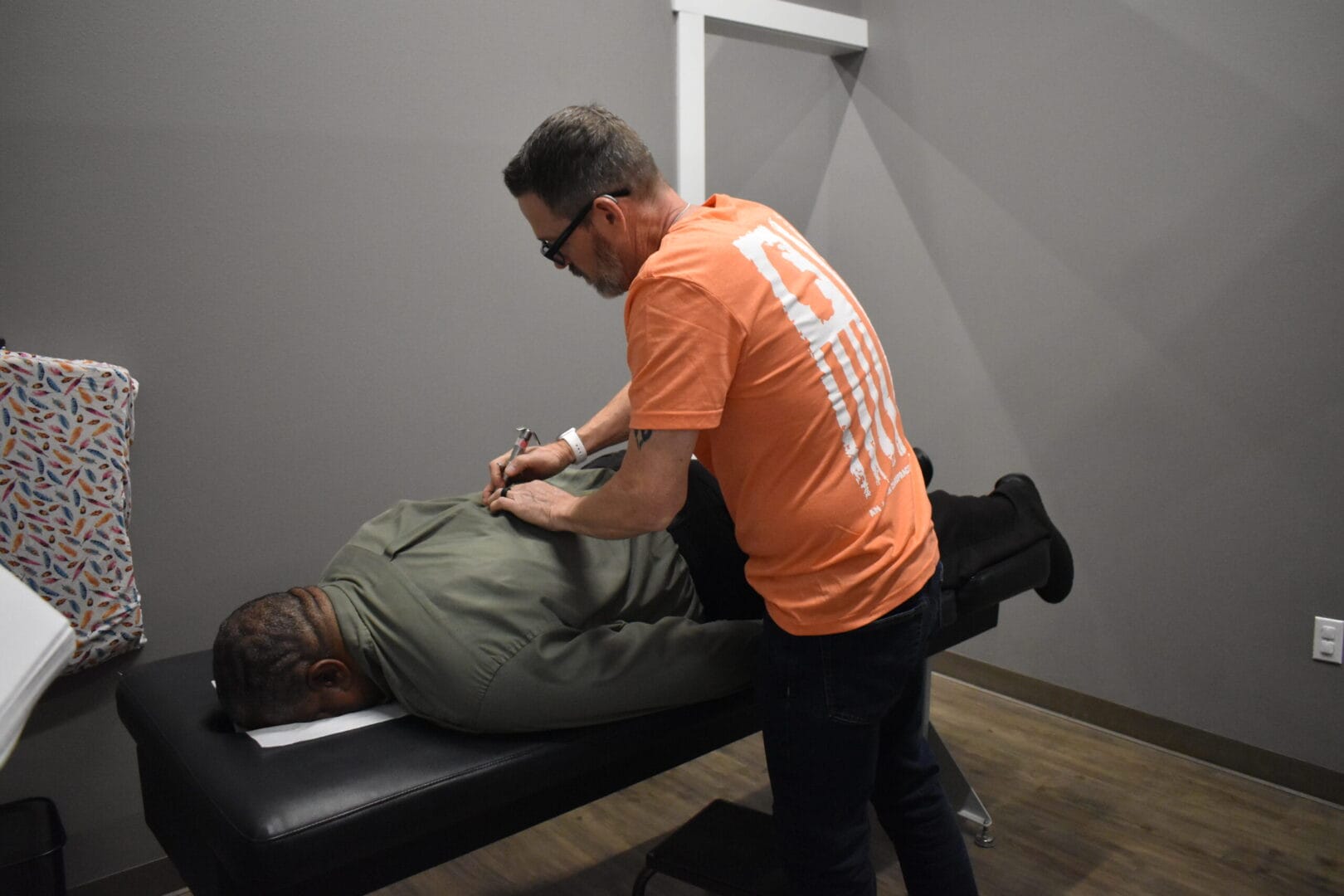
If you've been to a chiropractor before, you probably picture the same thing most people picture: hands on the spine, a quick movement, a pop, the practitioner saying "good?" and you saying "yeah, thanks." That's manual adjustment — and it's been the standard chiropractic technique for over a century.
It works. It also isn't right for everyone.
At Authority Chiropractic, we use Torque Release Technique (TRT) — an instrument-based approach that delivers the same kind of nervous-system regulation as manual adjustment, but through a fundamentally different mechanism. Both are legitimate. Both have research behind them. The question is which one fits you.
How manual adjustments work.
A manual adjustment is exactly what it sounds like: the practitioner uses their hands and body to move a specific spinal segment through its normal range of motion, often quickly. The "pop" you hear is gas releasing from the joint capsule — same physical phenomenon as cracking your knuckles.
What's actually happening is more interesting than the pop. The quick movement stimulates mechanoreceptors in the joint capsule, which sends a flood of sensory input to the nervous system. That input helps "reset" the muscle tension and joint position around that segment. The pop itself doesn't matter — it's just an audible byproduct.
Done well, manual adjustment is effective and safe. Done by a skilled practitioner on the right patient for the right condition, it produces excellent results and many patients prefer the experience.
How TRT works differently.
Torque Release Technique uses a small handheld instrument called the Integrator. Instead of moving the joint manually, the Integrator delivers a brief, precise mechanical impulse to a specific point on the spine. No twisting, no rotation, no body weight involved. The force is consistent every time and is calibrated to be far less than a manual adjustment.
What changes is how the nervous system receives the input. Instead of a broad sensory flood from joint movement, TRT delivers a targeted neurological signal — like ringing a bell at a specific frequency rather than playing a chord. The mechanism for restoring nervous system regulation is the same; the path to it is different.
A key difference. Because TRT uses a consistent instrument-delivered force, the adjustment is highly repeatable. Different practitioners produce nearly identical results, which matters in multi-doctor practices. Your treatment doesn't depend on which doctor you see that day.
What's the same. What's different.
Both techniques are evidence-based. Both can effectively reduce nervous system stress, restore joint function, and address subluxations. The differences are mostly in how they feel and who they're best suited for.
- Force: Manual adjustment uses higher force; TRT uses lower force.
- Sensation: Manual adjustment often produces a pop; TRT produces a quick tap.
- Patient effort: Manual adjustment requires you to relax into specific positions; TRT typically uses one position throughout.
- Adjustment time: Both are quick — usually 15 minutes or less for the actual care portion.
- Variability: Manual adjustment varies based on practitioner technique; TRT is highly consistent practitioner-to-practitioner.
- Patient population: Manual works for most adults in good health; TRT works for everyone from newborns to seniors, including pregnant women and patients with osteoporosis.
Who TRT tends to work especially well for.
TRT is the technique we use across the practice, but it's particularly good for certain patient profiles:
People who don't want to be cracked. If the idea of a manual adjustment makes you tense up before you even get on the table, TRT solves that. There's no popping, no twisting. Many patients describe it as relaxing.
Children and infants. Manual adjustments aren't appropriate for very young patients, but TRT is. It's gentle enough for newborns and effective enough for teenagers.
Pregnant women. TRT's low force and side-lying positioning make it ideal for prenatal care throughout all three trimesters.
Older adults and people with osteoporosis. Lower force means we can adjust patients who couldn't safely receive manual adjustments due to bone density concerns.
Patients with chronic conditions. The consistent, repeatable nature of TRT is well-suited to longer-term care plans for complex cases.
Patients who've tried manual chiropractic without sustained results. Sometimes a different mechanism produces different results. We see this often.
When manual adjustment might be the better fit.
Manual adjustment can be a strong choice for certain patients too:
- Athletes and active adults who want a "harder" feeling adjustment
- Patients who specifically prefer the experience of manual care
- Specific conditions where rotational adjustments are particularly indicated
- Patients comfortable with — and unaffected by — traditional adjustments
If manual adjustments have been working well for you, there's no reason to switch. Both approaches can deliver excellent care.
The research on TRT specifically.
TRT was developed through randomized clinical trials — uncommon for chiropractic techniques, most of which evolved through clinical experience rather than formal research. The original studies showed measurable improvements in spinal subluxations, muscle tension, and patient-reported outcomes compared to other approaches.
What makes TRT particularly interesting from a research perspective is its repeatability. Because the instrument delivers consistent force every time, study results are reproducible — which has historically been a challenge in chiropractic research where practitioner technique introduces variability.
How to decide what's right for you.
If you're choosing between practitioners and one uses manual adjustment while the other uses TRT, the honest answer is: both can work. The right choice depends on:
- Your comfort level with the techniques
- Your specific situation (age, conditions, pregnancy status)
- The practitioner's skill — which matters more than the technique itself
- Whether you've tried one and not the other
If you're uncertain, the best move is to schedule a consultation, ask questions, and watch a demonstration before committing. Any good practitioner — manual or instrument-based — will be happy to show you the technique before adjusting you.
If you want to experience TRT.
For more on the technique itself, see our Torque Release Technique page. To get evaluated and feel what TRT is like firsthand, call (210) 343-5209 or book online.
The first visit is a real evaluation — and we'll show you the Integrator, walk you through the technique, and answer any questions before any care happens.