The average American checks their phone 144 times a day. Each check involves about 60 degrees of forward head tilt. That's roughly 60 pounds of effective weight on the cervical spine — every glance, every text, every scroll.
The result is what's now called tech neck — and it's the most common posture-related condition we see in our office. Stiff necks, tension headaches, shoulder tightness that won't quit, and that nagging sense that no amount of stretching seems to actually fix it.
If that's familiar, you're not imagining it. And the reason stretches and heating pads aren't working has to do with what's actually happening in the cervical spine — and how your nervous system is responding to it.
What "tech neck" actually is.
Your head weighs about 10–12 pounds when balanced directly over your shoulders. Tilt it forward 15 degrees, and the effective load on your cervical spine roughly doubles. Tilt it forward 60 degrees — the position most people hold their phones at — and you're asking your neck to support around 60 pounds of pressure.
Hold that position for hours a day, every day, for years, and your cervical spine adapts to it. The natural curve of the neck flattens. The deep stabilizing muscles weaken. The superficial muscles tighten to compensate. The discs between the vertebrae compress unevenly.
That's the structural side. The neurological side is what most chiropractors miss.
Why the nervous system makes it worse.
Your upper cervical spine — the top three vertebrae — is the most neurologically dense region of your body outside the brain itself. The brainstem sits right above it. The vagus nerve passes through. Critical autonomic functions get regulated through this area.
When forward head posture creates chronic mechanical stress in this region, it doesn't just cause neck pain. It can dysregulate the nervous system itself — keeping the body stuck in low-grade fight-or-flight, which then keeps the muscles around the neck tight, which then makes the original problem worse. A self-reinforcing loop.
This is why stretching alone often fails. The muscles aren't tight because they're weak — they're tight because the nervous system is telling them to be tight. Stretching gives temporary relief, then they tighten right back up, often within hours.
What it feels like (beyond just neck pain).
Tech neck symptoms aren't always confined to the neck. The most common patterns we see:
- Stiffness in the morning that takes 30+ minutes to loosen
- Tension headaches that build through the day
- Pain or burning between the shoulder blades
- Reduced range of motion when checking blind spots while driving
- Numbness or tingling in the fingers (the nerves to the arms exit at this level)
- Disrupted sleep from inability to find a comfortable position
- Increased anxiety or feeling "wired but tired"
That last one surprises people. Chronic upper cervical stress affects the autonomic nervous system, which affects mood and stress regulation. People who address tech neck often report feeling calmer — even though they came in for pain.
What actually works.
The pieces that make a real difference, in order of importance:
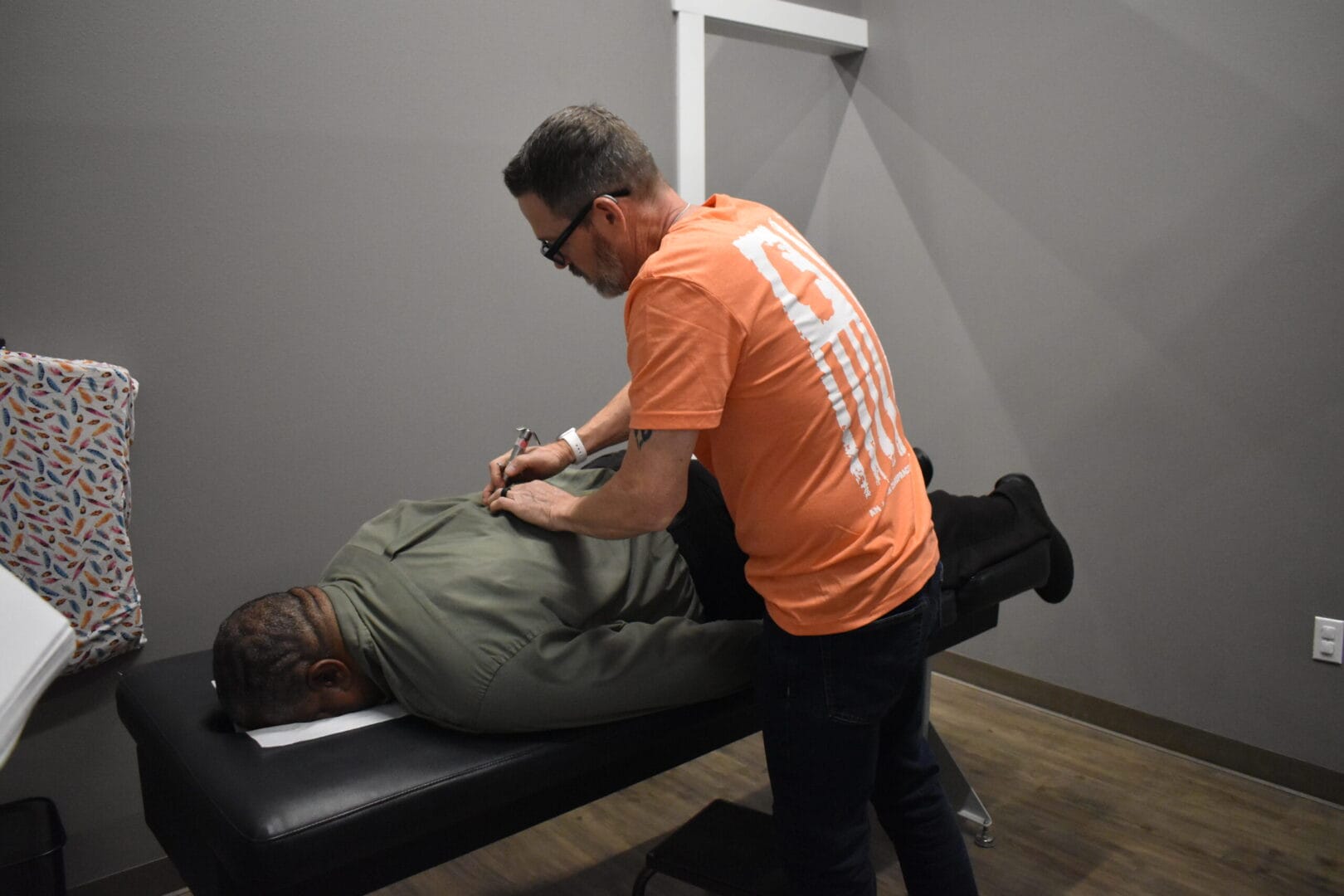
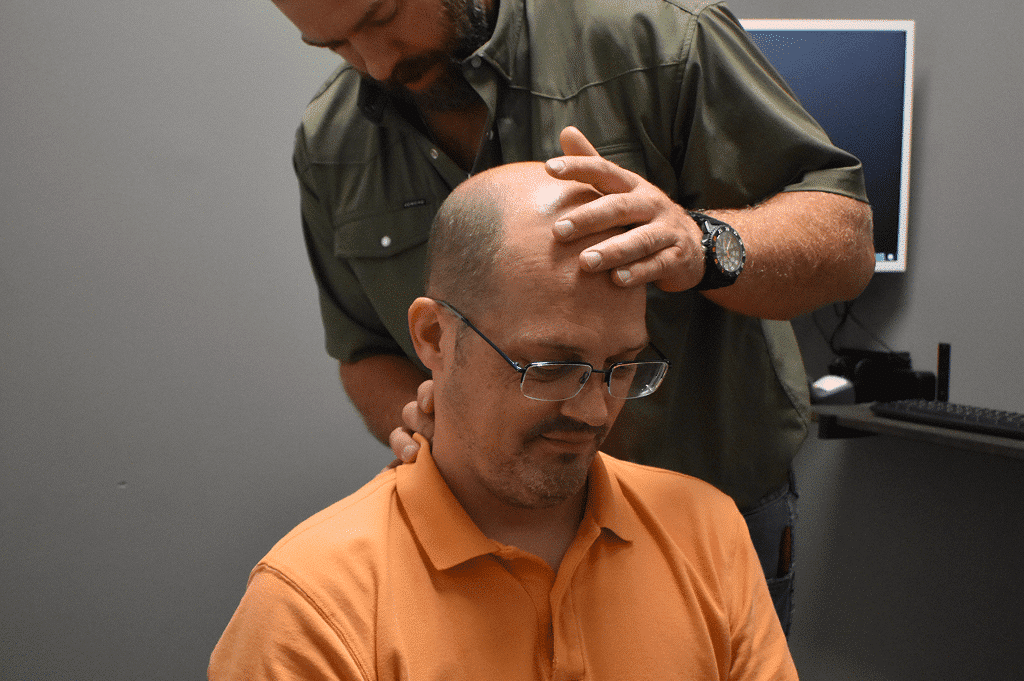
Address the nervous system, not just the muscles. Neurologically-based chiropractic care targets the upper cervical spine specifically — gentle, instrument-based adjustments that reduce the nerve irritation driving the muscle tension. When the nervous system calms down, the muscles release naturally. No forcing, no cracking.
Change the daily input. Adjustments don't last if you spend 8 hours a day reinforcing the original problem. Phone-at-eye-level (not chin-down). Workstation set up so the monitor is at eye height. Breaks every 30 minutes to look up and around. These aren't optional.
Strengthen the deep stabilizers. The deep neck flexors get weak with chronic forward head posture. Specific exercises to wake them back up matter. Generic neck stretches don't address this — and often make it worse by stretching the already-overlengthened muscles.
Sleep position matters more than people think. Stomach sleeping is the worst position for tech neck recovery. Side sleeping with a properly supported pillow is best. Back sleeping with a thin pillow works if you can manage it.
How long it takes to fix.
Honest answer: it depends on how long you've had it and how committed you are to changing the daily input. Most patients notice changes within the first 2–4 weeks of consistent care. Real structural changes (the cervical curve restoring, the deep stabilizers regaining function) take longer — usually 8–16 weeks.
The good news: tech neck responds well to treatment, especially when caught before significant degeneration sets in. Most patients who commit to the process feel meaningfully better within a couple of months and stay better as long as they maintain the daily habits.
If you're tired of stretching for relief that doesn't last.
If you've been managing neck pain with heating pads, stretches, and over-the-counter meds — and you've started to wonder if there's something more — tech neck is worth taking seriously now. Left alone, it doesn't improve on its own. The cervical spine continues to adapt to the forward head posture, and the longer that goes on, the harder it is to reverse.
For more on the conditions we treat in this region, see our neck pain page. To get evaluated, call (210) 343-5209 or book online. We'll do a real exam, look at the cervical curve on X-ray, and give you a clear assessment of where you actually are.