If you've been told you need back surgery, you're not alone — and you might also not need it.
Surgical consults for disc herniations, sciatica, and chronic low back pain are routine in San Antonio. What's less routine is being told upfront how often these surgeries fail to provide lasting relief, or how often the same conditions resolve with conservative care that nobody mentioned.
This isn't an anti-surgery article. Some cases genuinely need surgery, and we'll send patients to a surgeon when that's the right call. But before you commit to an irreversible procedure, there are questions worth asking — and a non-surgical option most patients aren't told enough about.
Why surgery often isn't the only path.
Most spinal surgeries are addressing one of three things: a disc that's bulging or herniated and pressing on a nerve, narrowing of the space the spinal cord runs through (stenosis), or chronic mechanical instability. The surgical approach removes tissue, fuses joints, or installs hardware to relieve pressure or stabilize the spine.
What's worth knowing: a meaningful percentage of disc herniations resolve on their own, with conservative care, given enough time. MRI studies have shown disc reabsorption — the herniated material physically retreating back toward its proper position — in over half of patients receiving consistent non-surgical treatment.
Surgery is the right answer when conservative care has been tried and failed, when the symptoms are progressively worsening despite intervention, or when there's a true emergency. It's a less obvious answer when conservative care hasn't been tried at all — which is more common than most patients realize.
What spinal decompression actually does.
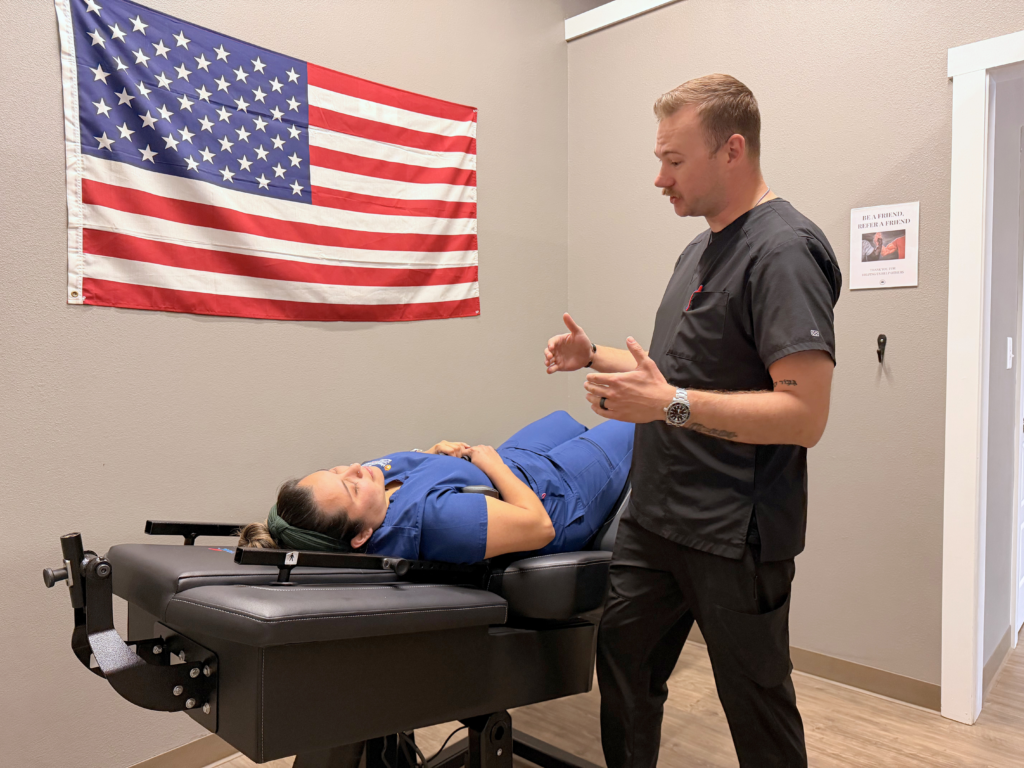
Spinal decompression therapy is a non-surgical, FDA-cleared treatment that gently and precisely creates negative pressure inside the spinal disc. That negative pressure does two things: it helps draw bulging or herniated disc material back toward the center of the disc, and it improves circulation of nutrients into the disc tissue itself (which doesn't have its own blood supply and depends on this kind of pressure cycling for healing).
It's not traction — older traction tables pulled in straight lines and often made symptoms worse. Modern decompression systems use computer-controlled cycles, target specific spinal segments, and apply just the right pressure to allow the disc to decompress without triggering the muscle guarding that compresses it further.
Sessions are 15 to 30 minutes. Most patients describe them as relaxing — many fall asleep. Treatment is usually a series of sessions over several weeks, with most patients noticing meaningful changes within the first 5 to 10 sessions if it's going to work for them.
Seven questions to ask before surgery.
If you're sitting across from a surgeon discussing your options, here's what we'd want you to ask:
1. What conservative options have I exhausted? If the honest answer is "physical therapy and pain medication," that's two of many. Spinal decompression, neurologically-based chiropractic, and other non-surgical interventions deserve consideration too.
2. What's the realistic success rate for this specific procedure on someone with my exact condition? Surgical success rates vary widely by procedure, by surgeon, and by patient profile. The general number you might find online isn't necessarily yours.
3. What's the recovery timeline, and what's life like during recovery? Some procedures have months-long recovery with significant limitations. That's not necessarily a reason to skip surgery, but it should factor into the decision.
4. What happens if the surgery doesn't work? "Failed back surgery syndrome" is a real condition with its own ICD code. Knowing the failure scenarios — and what comes next — matters.
5. Are there hardware risks I should know about? Fusions, screws, and disc replacements have specific failure modes. Not common, but real.
6. Can I get a second opinion before deciding? Yes, you can. Always. Surgeons expect this and good ones encourage it.
7. What would happen if I waited and tried 6–8 weeks of conservative care first? For non-emergent cases, the answer is usually "nothing — and you might not need surgery after that." If the answer is "your condition will worsen," ask exactly how, and how quickly.
There are situations where surgery is genuinely urgent — sudden loss of bowel or bladder control, progressive weakness, severe numbness in the saddle region. In those cases, conservative care is not the right path. Go to the ER or a surgical specialist immediately.
How decompression compares.
For the right patient, the comparison looks like this:
- Surgery: Permanent change to anatomy. Recovery measured in months. Higher upfront cost (or insurance complexity). Higher risk profile. Often effective for the cases it's designed for.
- Decompression: Non-invasive. No anesthesia. No recovery time. Sessions are short and comfortable. Lower risk profile. Effective for disc-related and nerve-compression cases — not for every back pain cause.
The honest case for decompression isn't that it's a miracle. It's that for the conditions where it works — disc herniations, bulging discs, sciatica from nerve compression, certain types of chronic low back and neck pain — it often resolves the issue without surgery. And if it doesn't, you haven't lost anything; surgery is still on the table.
Who decompression is for. And who it isn't.
Good candidates typically have:
- Herniated or bulging lumbar or cervical discs
- Sciatica from disc-related nerve compression
- Chronic back or neck pain that hasn't resolved with PT or medication
- Pre-surgical situations where conservative care hasn't been tried
Decompression is generally not recommended for:
- Spinal fractures
- Severe osteoporosis
- Spinal instability or hardware from previous surgeries
- Pregnancy
- Certain tumors or infections
This is why the first step is always evaluation — not jumping straight into treatment. We want to know what we're dealing with before we recommend anything.
If you're facing this decision.
Before you commit to surgery, get a real evaluation of your conservative options. Bring your imaging. Bring your surgical recommendation. We'll give you an honest read on whether decompression is likely to help in your specific case — and if it isn't, we'll tell you that too.
Call (210) 343-5209 or book an evaluation online. The first visit is a real conversation, not a sales pitch — and the goal is helping you make the best decision for your body, not selling you on ours.