
If you've had headaches long enough, you've probably been told some version of "everything looks normal." The bloodwork was clean. The imaging was clean. The neurologist found nothing structural. And you still woke up with your head pounding.
That's the frustrating part for most of the people who end up in our San Antonio office. Nothing is technically wrong — and yet something clearly is. Medication takes the edge off for a few hours, then the headache comes back on schedule, and you're left managing a problem nobody has actually explained to you.
Here's what we do differently at Authority Chiropractic, and why it works for the headaches that haven't responded to anything else.
We find out what's actually causing them before we treat anything.
This is the part most people have never had done — including plenty who've already been to other chiropractors in San Antonio. A real headache evaluation isn't someone pressing on your neck and guessing.
We start with your actual history — when the headaches hit, how long they last, what sets them off, where the pain sits, what you've already tried. Patterns matter. A headache that arrives every afternoon behind one eye is telling a different story than one that wakes you at 4 a.m. or one that started after a car accident.
Then we image. Digital X-rays show us the actual position of your cervical spine, and a nervous system scan shows us how well your nerves are communicating through it. Only after that do we build a care plan — because a plan built before the exam is a guess, and you've probably had enough of those.
It's also how we catch the cases that aren't ours. If your imaging or your history points somewhere outside what chiropractic care addresses, we'll tell you and refer you out. We've written about why that honesty matters — an evaluation where everyone is a candidate isn't an evaluation.
Most chronic headaches trace back to the upper cervical spine.
The vertebrae at the top of your neck sit directly beneath the base of your skull, surrounded by the nerves that supply your head and face. When they're even slightly out of position, they irritate the nerves and muscles that radiate pain up into the head.
That's why so many headaches don't respond to headache medication — the drug works on the symptom while the mechanical cause sits untouched. It's also why the pain often doesn't feel like it's coming from your neck at all. Cervicogenic headaches are referred pain by definition: the source is in the neck even though the pain shows up in your head.
We see the full range of it in San Antonio — tension headaches with that dull band of pressure, migraines with one-sided throbbing and light sensitivity, cluster headaches that hit around the eye at the same time every day. Different presentations, frequently the same underlying mechanical driver.
Torque Release Technique first — and hands-on adjusting when that's the better fit.
Most people bracing for a chiropractic adjustment are picturing one thing: a forceful twist and a loud pop. That's part of what we do — but it isn't where we start, and it isn't right for everyone.
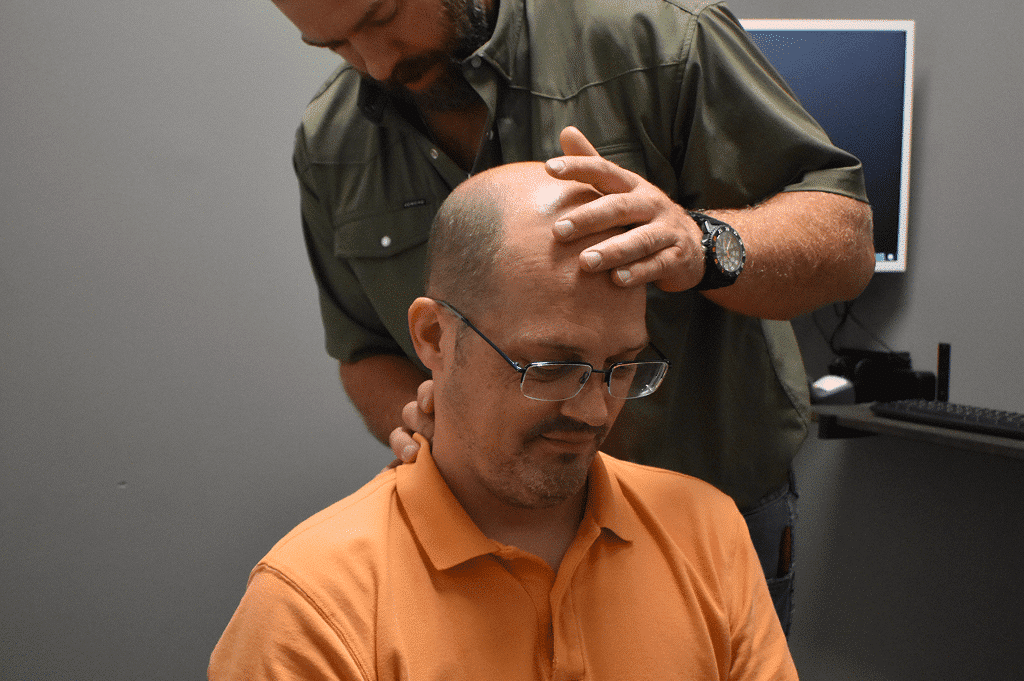
Torque Release Technique is our primary adjustment method. It uses the Integrator — a small, FDA-approved handheld instrument that delivers a fast, low-force, highly specific impulse to the exact segment that needs it. No twisting, no forceful manipulation, specific down to the millimeter. For headache patients that precision matters more than usual, because the upper cervical spine is a small, sensitive area and the correction has to land in the right place. It's also why patients who'd never agree to being twisted will sit down for care at all — which, when your head already hurts, is a lot of them.
But TRT isn't automatically the answer for every patient or every presentation. Traditional manual adjusting — hands-on, audible release included — is still the better tool in plenty of cases, and we use it when your exam says so.
Which one you get isn't a house preference. It's a decision based on your imaging, your exam, and what your spine actually responds to — the same way the rest of your care plan gets built.
If every test came back normal, that doesn't mean nothing is wrong. It usually means nobody has looked at how your spine and nervous system are actually functioning.
When imaging shows compression, we add decompression.
Not every headache patient needs this. But when the exam shows the pain is driven by mechanical compression — a pinched cervical nerve, disc involvement pressing on structures in the neck — an adjustment alone is working against pressure that's still there.
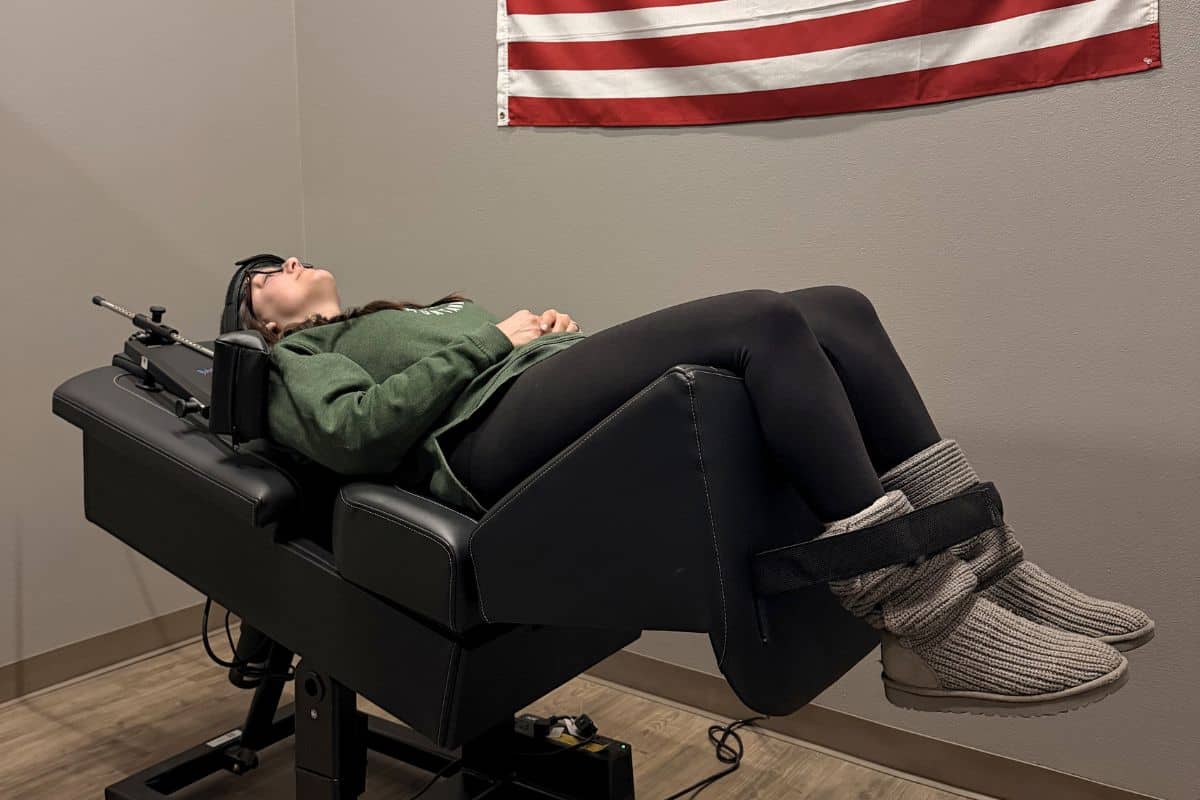
That's where cervical spinal decompression comes in — our Cervi-Trac system, an FDA-cleared cervical attachment that gently decompresses the neck, creating space and taking pressure off the nerve. It's the same decompression principle we use on the lumbar spine with Back On Trac, applied to the cervical spine instead — and both live on site at our San Antonio office, so decompression becomes part of your care plan rather than a referral across town.
We use it when it's indicated, and we don't when it isn't. That's the difference between a care plan and a package.
Why the combination is what actually lasts.
This is the piece that matters most, and it's the reason our San Antonio headache patients stay.
Adjustments give you relief you can feel — often quickly. Decompression addresses the mechanical pressure generating the problem in the first place. Do only the first and you get relief that fades and returns. Do only the second and you're treating structure without restoring how the nervous system communicates through it.
Together they work on both timelines at once: the headache you have today, and the mechanism that keeps producing new ones. That's the difference between managing headaches indefinitely and getting to a point where you stop planning your week around them.
We're not going to promise you'll never have another headache — nobody honest will. What we will tell you, after your exam, is whether what's driving yours is something we can correct, how long we'd expect it to take, and what it involves. Then you decide.
Find out what's actually causing your headaches in San Antonio.
If you've been managing headaches for years without ever being told what's causing them, that's the place to start. Our office is on N Loop 1604 W in San Antonio, and a real evaluation — history, digital imaging, nervous system scan — will tell you what's driving your headaches and whether we're the right people to fix them.