
The first time, you barely registered it. You lifted a box wrong, or you slept at a strange angle, and for a week you moved carefully and it settled down on its own.
Then it came back a few months later. Then again the following spring, and that time it hung around longer. Somewhere in there you started keeping ibuprofen in the car, and "my back went out again" turned into a normal sentence you say to people.
That's the pattern almost everyone describes by the time they end up in our office — not one injury, but a series of episodes, spaced further apart at first and then closer together, each one taking a little longer to quiet down.
Here's the part worth sitting with: the episodes aren't the problem. Whatever keeps producing them is.
Feeling better and being better aren't the same thing.
Pain is a terrible progress report. It tells you how irritated the tissue is right now, and almost nothing about whether the thing that irritated it has changed.
So the sequence goes like this. Something in your lower back gets overloaded. The area inflames, the surrounding muscles tighten up to guard it, and moving hurts. Over a week or two the inflammation settles and the muscles stop bracing — and you feel fine. Genuinely fine, not pretending.
But the reason that segment got overloaded in the first place is still there. A joint that isn't moving the way it should, a disc that's carrying more load than it was built for, an alignment issue that quietly concentrates stress on one level of your spine. None of that resolves because the pain did. You return to normal life, put normal demands on a back that hasn't actually changed, and the clock starts again.
That's also why the gaps get shorter. Each episode leaves the area a little more irritated and a little quicker to guard, so it takes progressively less to set off the next one. People read the shortening intervals as aging. Usually it's accumulation.
Rest, heat, and "strengthen your core" are aimed at the episode.
None of that is bad advice. It's just pointed at the flare rather than the cause.
Rest works by lowering demand, which is exactly right in the first few days of an acute episode. It doesn't change the mechanics — it pauses them. Heat and anti-inflammatories work on how loudly the area is complaining. When they wear off, everything they were quieting is still there.
Core strengthening is the closest of the three to addressing something real, and for plenty of people it genuinely helps. But building support around a segment that isn't moving properly reinforces the pattern rather than resolving it. You get a stronger structure holding the same restriction in place. That's often why people describe months of diligent exercises that made them feel more capable without making the episodes stop.
None of this means your back pain is untreatable. It means you've been managing episodes, which is a completely reasonable thing to do when nobody has told you what's actually restricted down there.
When the pain starts moving, that's compensation.
One of the more reliable signs that something structural is unresolved is that the pain doesn't stay put.
Your body is good at routing around a problem. When one area of the lumbar spine isn't moving well, the segments above and below take on load they weren't designed for, your hips and pelvis adjust how you walk, and the effects travel. It shows up as hip, knee, or shoulder pain that seems entirely separate from your back — and gets treated as a separate problem, by a separate person, with its own separate plan.
There's one migration pattern worth naming specifically. If the pain starts travelling down a leg — past the glute, into the hamstring, sometimes to the calf or foot — that's a different mechanism, and it's a nerve being compressed rather than a muscle complaining. It changes what treatment needs to do.
We image the lower back before we treat it.
Most people who've had recurring back pain for years have never had anyone actually look at their spine.
We start with the history, and specifically with the trajectory: when the episodes started, what sets them off, what relieves them, what you've already tried, and whether they're getting closer together. How this year compares to three years ago tells us more than how bad this particular week is.
Then we image. Digital X-rays show us the real condition and alignment of your lumbar spine, and an on-site nervous system scan shows how well your nerves are communicating through it. Some back pain is muscular, some is disc-related, some is neurological, and those aren't the same problem — which is why we'd rather see it than infer it. Only after that do we put a plan together.
It's also how we find the cases that aren't ours. Most recurring back pain is mechanical and responds well to conservative care. Some doesn't. If your history or your imaging points somewhere else, we'll say so and refer you out — an evaluation where everyone turns out to be a candidate isn't really an evaluation.
Back pain with progressive weakness in a leg, numbness through the groin or saddle area, or any loss of bladder or bowel control is a medical emergency — not a chiropractic appointment. Go to an emergency room. The same goes for back pain that follows significant trauma, or that arrives alongside fever or unexplained weight loss. These presentations are uncommon, but they're the ones where waiting matters.
What breaking the cycle actually involves.
Most people with an irritated lower back are braced for someone twisting it. That isn't where we start.
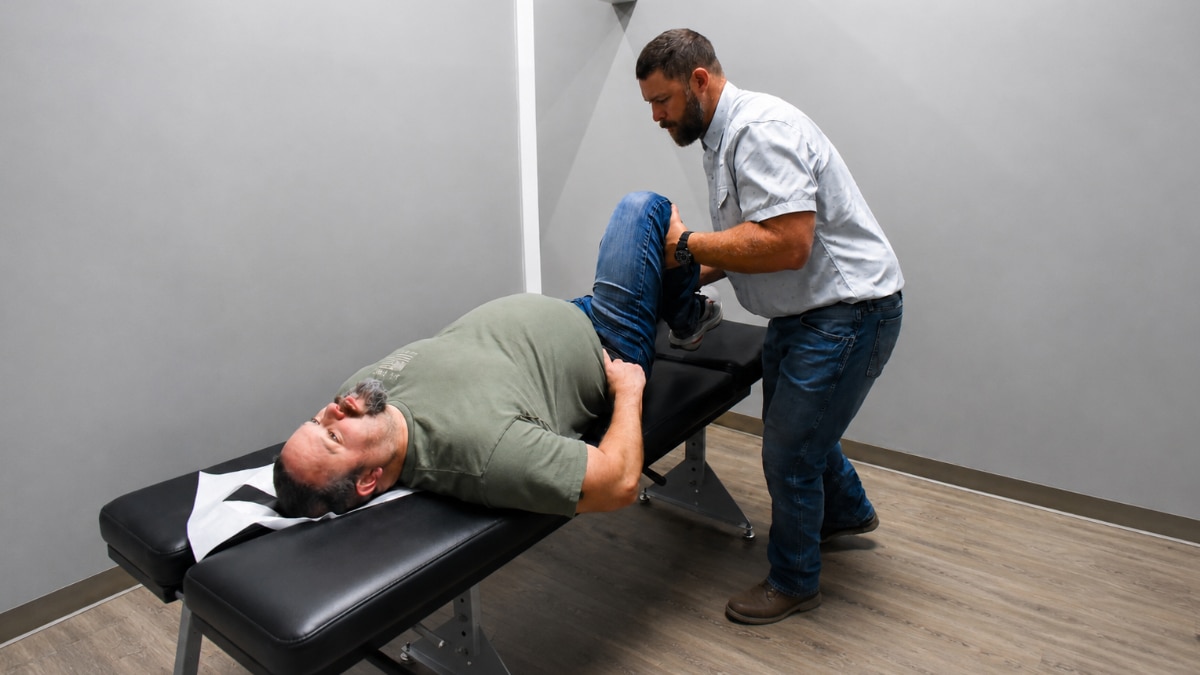
Torque Release Technique is our primary adjustment method. It's instrument-based rather than manual — the Integrator delivers a fast, low-force, highly specific impulse to the exact segment that needs it. No twisting, no cracking, no forceful manipulation. When the area is already inflamed, that precision is the difference between correcting a segment and aggravating everything around it. Traditional manual adjusting is still the right tool for some presentations, and we use it when the exam calls for it.
When imaging shows the pain is being driven by disc compression or degenerative change, we add non-surgical spinal decompression. Back On Trac is an FDA-cleared, hands-free system for the lumbar spine that gently opens the disc space and takes pressure off the disc and nerve directly. Sessions run 12 to 15 minutes and you can go straight back to work afterward.
The reason it's often both: adjustments restore motion and nerve communication through the segment, and decompression relieves the pressure that's sitting on it. Recurrence lives in the mechanical fault. Addressing function without space, or space without function, tends to buy you a longer gap rather than an end to the cycle.
How long before it stops coming back.
Honest answer: it depends on how long this has been going on and what your imaging shows, and we won't know either until after your exam.
The shape of it looks like this. Acute back pain sometimes shifts after the first or second adjustment. Pain you've been cycling through for years usually takes a few weeks of consistent care before things change — your body has adapted around the pattern, and unwinding that takes longer than creating it did. If decompression is part of the plan, most patients notice meaningful changes within the first 5 to 10 sessions, and a full course typically runs 20 or more spread over a few months.
What we won't tell you is that the pain will never return. Nobody honest will. What you'll get after the exam is a straight answer on whether what's driving your episodes is something we can correct, roughly how long we'd expect that to take, and what it involves. Then it's your call.
Find out what keeps bringing your back pain back.
If your back has been going out on a schedule for years and nobody has ever shown you why, that's the place to start. Our office is on N Loop 1604 W in San Antonio, and a full evaluation — history, digital lumbar imaging, nervous system scan — will tell you what's actually generating the episodes and whether we're the right people to correct it.