It usually starts in the lower back or deep in one side of your backside, and then it travels. Down the hamstring. Past the knee. Sometimes all the way into the calf and foot. Some days it's a heavy ache you can work around. Other days it's electric — a shock that fires the length of your leg when you stand up wrong, and you freeze in the kitchen waiting for it to pass.
You've stretched it. You've been told to rest, then told to move more. You've probably taken something for it, and it helped for an afternoon. And it keeps coming back.
Here's the part that tends to get skipped: sciatica isn't a diagnosis. It's a description of where you feel pain. The actual problem is somewhere else entirely — and until someone finds it, you're treating a symptom and hoping.
Sciatica is a symptom. The compressed nerve is the problem.
The sciatic nerve is the largest nerve in your body. It's formed from nerve roots that exit your lower lumbar spine, merges near the pelvis, runs through the glute, and travels down the back of the leg toward the foot. It's roughly the diameter of your thumb where it starts.
When something narrows the space one of those roots passes through, the nerve gets compressed — and it reports that compression along its entire length. That's the whole mechanism. The narrowing is usually a bulging disc, a herniation, or years of accumulated mechanical stress that has quietly closed down the opening the nerve needs.
Which explains the thing that confuses most people: your leg hurts, and there is nothing wrong with your leg. Massaging the hamstring, rolling the glute, icing the calf — none of it reaches the problem, because the problem is six vertebrae north of where you feel it. This is the same reason a herniated disc can produce pain almost nowhere near the disc itself.
It's also why "sciatica" told you almost nothing when someone first said it to you. Two people with identical leg pain can have entirely different compressions at entirely different levels. The word describes the route. It doesn't describe the cause.
Why stretching and painkillers stop working.
They aren't useless. They're aimed at the wrong target.
Anti-inflammatories and pain medication change how loudly the signal registers. They don't move the disc, and they don't widen the space. When the dose wears off, the compression is exactly where it was — so the pain returns on schedule, and over time you need it more often to get the same afternoon of quiet.
Stretching is more interesting, because it often does help, briefly. Changing your position changes the pressure on the nerve for as long as you hold it. Then you sit back down at your desk, the pressure returns, and the relief expires. People read that short window as progress and repeat it for months.
Rest has the same problem in slower motion. Things calm down, you feel better, you resume your life, and the pain comes back — because nothing about the mechanics changed while you were on the couch.
None of that means your sciatica is untreatable. It means you've been treating the sensation instead of the compression, which is a reasonable thing to do when nobody has told you where the compression is.
We don't guess where the nerve is pinched. We image it.
This is the part most sciatica patients have never actually had done.
We start with the route your pain takes, because it's diagnostic. Pain that stops at the knee is telling a different story than pain that reaches the foot. We want to know what makes it worse — sitting, standing, bending forward, getting out of the car — how it started, whether it came on over months or arrived in a single morning, and whether anything has changed about the numbness or the strength in that leg.
Then we image. Digital X-rays show us the actual condition and alignment of your lumbar spine, and a nervous system scan shows us how well your nerves are communicating through it. Only after that do we build a care plan, because a plan written before the exam is a guess dressed up as a protocol.
It's also how we identify the sciatica that isn't ours to treat. Most of it is mechanical and responds well to conservative care. Some of it doesn't. If your history or imaging points somewhere else, we'll say so and refer you out — an evaluation where every single person turns out to be a candidate isn't really an evaluation.
Progressive weakness in the leg, numbness through the groin or saddle area, or any loss of bladder or bowel control is a medical emergency — not a chiropractic appointment. Go to an emergency room. That combination is rare, but it is the one presentation where waiting matters.
Torque Release Technique and Back On Trac — and why we use both.
Most people arriving with sciatica are bracing for one thing: someone twisting their lower back while it's already screaming. That is not where we start.
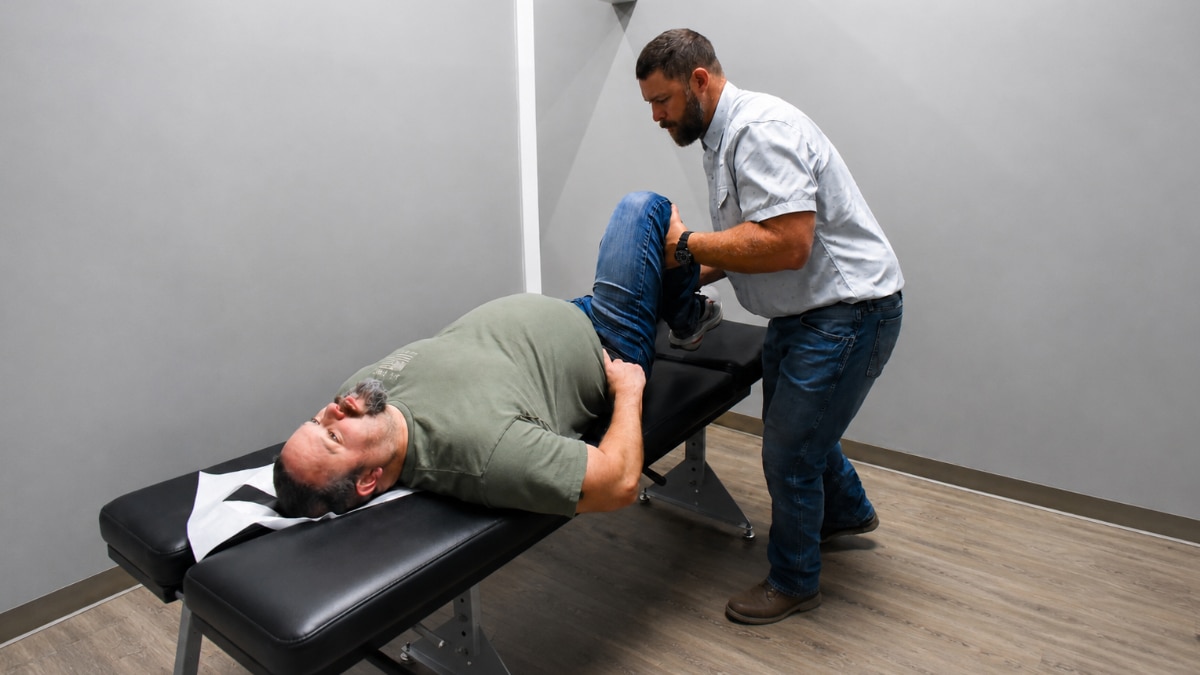
Torque Release Technique is our primary adjustment method. It uses the Integrator — a small FDA-approved handheld instrument that delivers a fast, low-force, highly specific impulse to the exact segment that needs it. No twisting, no forceful manipulation. For an irritated lumbar spine that precision matters, and frankly it's the reason a lot of sciatica patients agree to care at all. Traditional manual adjusting is still the better tool for some presentations, and we use it when your exam says so.
Adjustments restore motion and improve how your nervous system communicates through the segment. But if imaging shows the nerve is being physically crowded by a disc, an adjustment alone is working against pressure that's still sitting there.
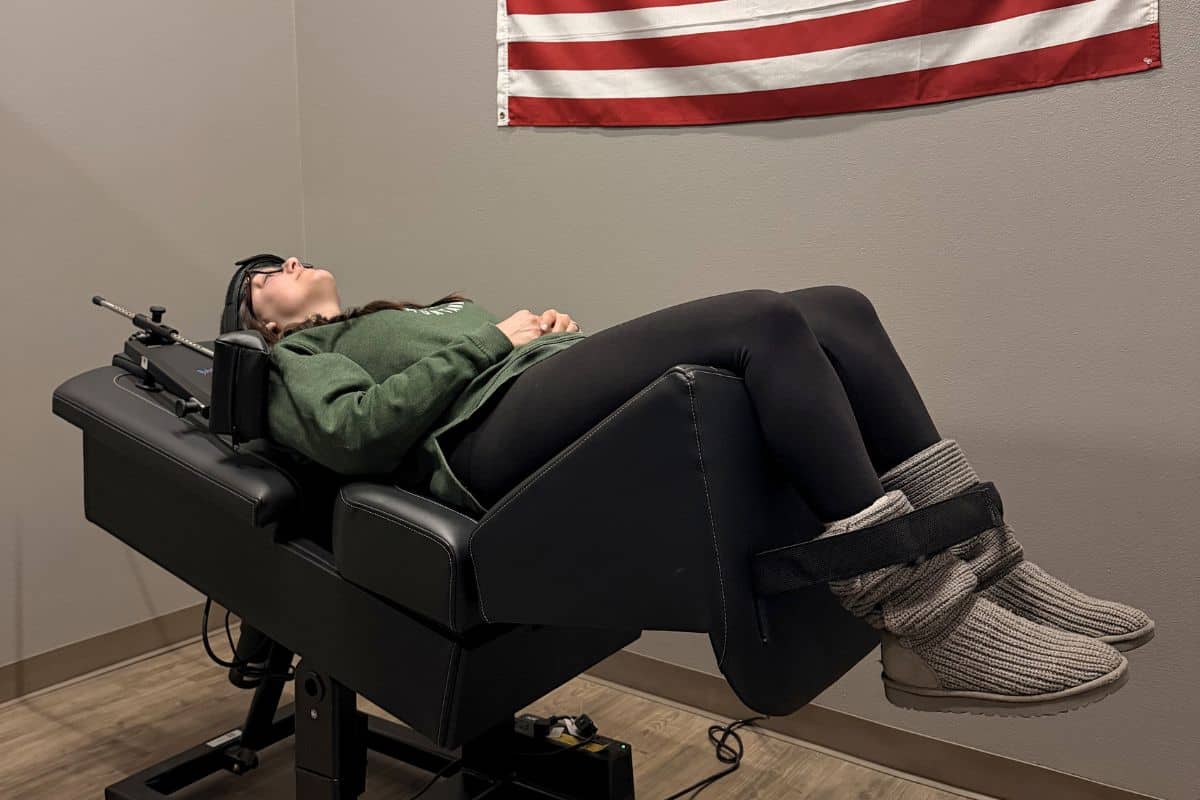
That's what non-surgical spinal decompression is for — our Back On Trac system, an FDA-cleared, hands-free decompression system for the lumbar spine that gently opens the disc space and relieves pressure on the disc and nerve directly. Sessions run 12 to 15 minutes. You lie there; the table does the work.
The combination is the actual point. Adjustments address function, decompression addresses the space. Do only the first and you're restoring motion around a nerve that's still crowded. Do only the second and you've opened the space without correcting what closed it down. Together they work on the pain you have now and the mechanism that keeps regenerating it.
How long sciatica relief actually takes.
Honest answer: it depends on how long the nerve has been compressed and what shape the disc is in, and we won't know either until after your exam.
What we can tell you is the shape of it. Most decompression patients begin noticing meaningful changes within the first 5 to 10 sessions. A complete course of care typically runs 20 or more. Sciatica that arrived three weeks ago behaves differently than sciatica you've been managing since 2019, and a disc that's bulging is a different timeline than one that's herniated.
We're not going to tell you the pain will never come back — nobody honest will. What you'll get after the exam is a straight answer on whether what's compressing your nerve is something we can address, roughly how long we'd expect it to take, and what it involves. Then you decide.
Find out what's actually compressing your sciatic nerve.
If you've been stretching, resting, and medicating your way through sciatica without anyone ever showing you where the compression is, that's the place to start. Our office is on N Loop 1604 W in San Antonio, and a real evaluation — history, digital lumbar imaging, nervous system scan — will tell you what's driving the pain down your leg and whether we're the right people to fix it.