Most people walk away from a car accident thinking the same thing: I'm okay. The car is driveable. It wasn't that bad. In the moment, that's usually true — the adrenaline and cortisol that flood your system during a crash do a remarkably good job of keeping you from feeling injured.
The problem is that it wears off. And when it does, the soft tissue damage, the disc pressure, the nerve irritation that were there all along start to announce themselves. By then, it's been two or three days. Some people wait weeks. A few never get checked at all — until the chronic pain sets in and they can't figure out why.
What happens in the first 72 hours after a car accident shapes how you recover. Here's what to do, in order — and where a car accident chiropractor fits into that sequence.
Step one: get yourself safe and document everything.
Before any medical evaluation, a few things need to happen at the scene. Move to a safe location if you can. Call 911 even if injuries aren't obvious — getting a police report on record matters for your insurance claim. Exchange information with all drivers involved: insurance, license plate, name, and contact. Take photos of the vehicles, their positions, visible damage, and the surrounding scene. Get names and contact information from any witnesses.
If you or anyone in the vehicle has severe pain, difficulty moving, neurological symptoms — numbness, tingling, sudden headache, confusion — don't move them. Wait for emergency services.
For most fender-benders and moderate impacts, you'll drive away from the scene. That's when the clock starts. The documentation you create at the scene becomes the foundation for everything that follows: your insurance claim, your medical record, and your recovery.
Go to the ER if you need to — but understand what it does and doesn't cover.
If there's any possibility of a serious injury — head trauma, internal pain, broken bones, loss of consciousness — go to the emergency room. That's not optional, and this article isn't a reason to skip it.
What the ER is excellent at: ruling out fractures, internal bleeding, concussion, and anything life-threatening. They'll X-ray the areas that hurt and clear you once they're confident nothing is broken or acutely dangerous. For many car accident patients, that's exactly what they need.
Here's what most people aren't told when they leave: a clear X-ray doesn't mean a clear spine.
X-rays show bone. They don't show soft tissue — the muscles, ligaments, tendons, and discs that absorb the brunt of a collision. Whiplash is a soft tissue injury. Disc herniations and bulges are soft tissue injuries. Nerve irritation from spinal misalignment doesn't show up on a standard X-ray at all. You can walk out of the ER with a normal report and still have a herniated disc developing in your cervical spine. The ER wasn't wrong — they found what X-rays find. It's just that the most common car accident injuries aren't visible on the imaging they use.
What's actually happening inside your body during a crash.
Even a relatively low-speed rear-end collision — 10 to 15 miles per hour — generates enough force to whip the cervical spine forward and back far beyond its normal range of motion. The muscles contract reflexively to protect the neck, the ligaments stretch beyond their limit, and the vertebrae can shift in ways that put pressure on discs and nerves.
The insidious part is that soft tissue injuries are typically at their least painful right after impact. The inflammatory process that causes pain hasn't fully kicked in. And if adrenaline is still in your system — which it usually is for several hours — your body is actively suppressing pain signals. This is why so many people feel fine at the accident scene and are in significant pain 24 to 48 hours later. The injury didn't get worse overnight. It just stopped being hidden.
The most common injuries that develop after car accidents:
- Whiplash (cervical strain/sprain): Muscle tightness, stiffness, headaches, and limited neck range of motion that often don't appear until the day after the crash.
- Disc herniations or bulges: Increased pressure during impact can push disc material against nerve roots, causing radiating pain, numbness, or tingling into the arms or legs.
- Spinal misalignment: Vertebrae shifted out of normal position during the collision can irritate surrounding nerves and disrupt nervous system communication.
- Ligament and soft tissue damage: Sprains and micro-tears in the stabilizing structures of the spine that won't appear on standard imaging but cause real pain and instability.
Why the first 72 hours create a window you don't want to miss.
Within hours of an injury, the body initiates an inflammatory response. Blood flow increases to the damaged area, fluid accumulates, and the healing process begins. Done well, this is adaptive — it clears cellular debris and starts laying down repair tissue. But inflammation that isn't addressed can become chronic, and the scar tissue that forms during the repair process can restrict movement and compress nerves in ways that create long-term problems.
The earlier a provider identifies what structures are injured and begins appropriate care, the more influence they have over how that healing process goes. Waiting two weeks means the body has already spent two weeks adapting to the injury — sometimes in ways that create secondary problems on top of the original one. Symptoms are rarely the whole story — and car accidents are a clear example of why.
There's also a practical dimension. In Texas, you have two years from the date of an accident to file a personal injury claim, but insurance adjusters scrutinize gaps in care. If you wait three weeks to see a doctor, the question "why did you wait?" becomes part of the conversation. Seeing a provider quickly and consistently builds a documented medical record that reflects the timeline of your injury and care — and that record protects you.
What a car accident chiropractor actually evaluates.
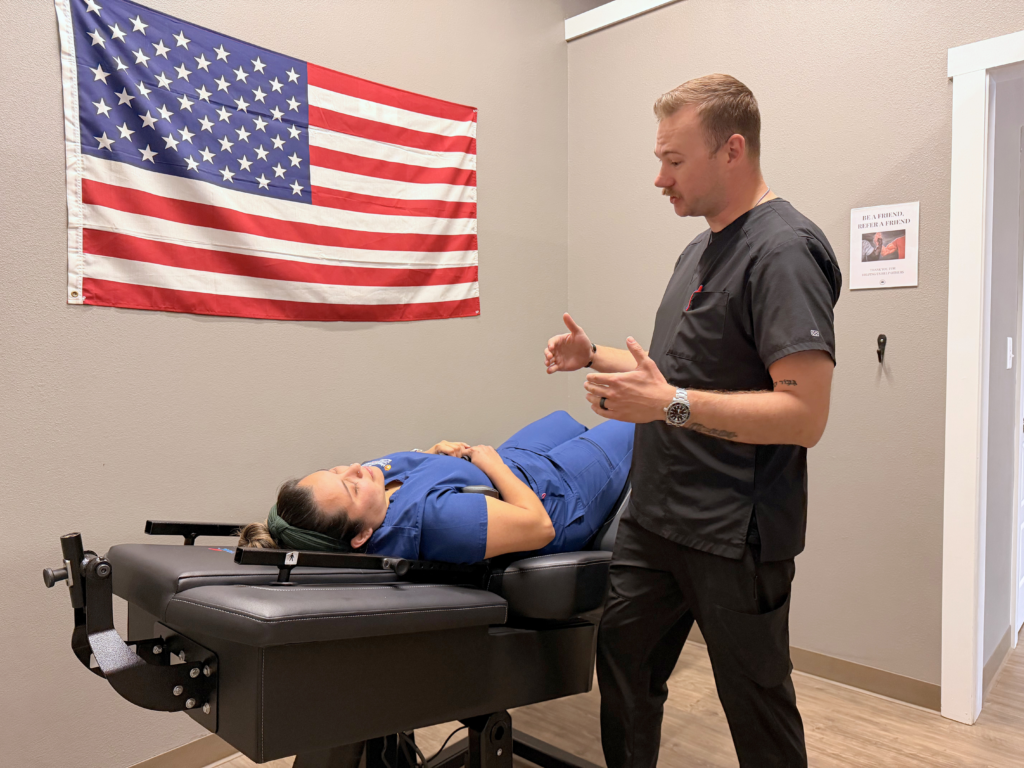
A car accident chiropractic evaluation goes well beyond where it hurts. The goal is to understand the full picture of what the collision did to your spine and nervous system — not just which muscles are sore.
At Authority Chiropractic, a post-accident evaluation covers:
- Neurological assessment: Testing nerve function, reflexes, and sensation to identify any nerve involvement that isn't causing obvious pain yet.
- Spinal range of motion: Documenting how the neck and back move, where restriction has developed, and what that indicates about underlying injury.
- Postural and alignment analysis: Identifying shifts in spinal alignment that resulted from the impact.
- Orthopedic testing: Specific provocation tests that help isolate which structures are injured and how severely.
- On-site digital imaging where indicated: When we need a clearer picture before recommending any treatment, we can image in-office — not a separate referral and another day's delay.
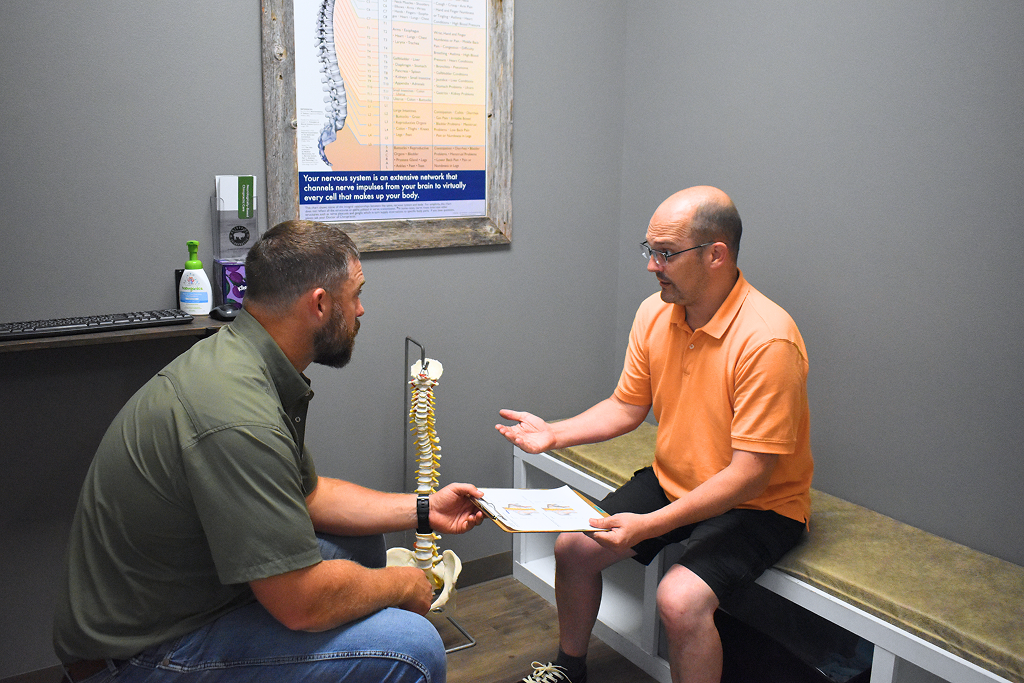
What comes out of that evaluation is an honest assessment: what's there, what it means, and what care makes sense for your situation. If your case needs a specialist, an orthopedist, or a referral to someone else, we'll say so. The goal is the right outcome — not a protocol that gets applied to everyone regardless of what the exam shows.
What about herniated discs from car accidents?
Disc injuries are among the most common — and most frequently missed — outcomes of vehicle collisions. The impact loads the spine in a direction and at a speed the body wasn't designed to absorb. A disc that was already under some stress can herniate; a healthy disc can bulge. Both can press on nerve roots in ways that cause radiating pain, arm weakness, or numbness that doesn't show up until days after the crash.
Standard X-rays won't show it. Even a clean MRI immediately after an accident can miss disc changes that emerge as the inflammatory response peaks over the following 48 to 72 hours. This is exactly why timing matters — and why a thorough evaluation that includes neurological testing, not just imaging, gives you a more complete picture than the ER discharge summary alone.
If your post-accident evaluation finds disc involvement, we treat disc injuries without surgery, using a combination of neurologically-based chiropractic care and, where indicated, spinal decompression. The specifics depend on what the exam and imaging show — which is why the evaluation comes first, always.
What to expect at your first visit after a car accident.
If you've never seen a chiropractor after an accident — or never been to a chiropractor at all — the first visit usually surprises people in the right direction.
There's no adjustment on the first day if your spine isn't ready for it. The first appointment is almost entirely evaluation: we listen, we examine, and we document. We find out exactly what happened, how you're feeling, and what you've noticed in the time since the crash. From there, a care plan is built around your specific injuries — not a standard whiplash protocol applied to everyone who walks through the door.
On the practical side: we accept most major insurance including policies with PIP (personal injury protection), and we regularly work with patients whose care is being managed through an auto insurance claim. The billing process after an accident is stressful enough — we keep our side of it straightforward and transparent.
Even if you feel okay right now, the 72 hours after a car accident are the window that shapes your recovery. A quick evaluation costs you an hour. Missing it can cost months of managing pain that was preventable.
If you were in an accident in San Antonio — even a minor one — and you haven't been evaluated yet, don't wait for the pain to show up before you act. Call us at (210) 343-5209 or book your evaluation online and we'll get you in quickly. We'll tell you honestly what we find and what to do about it — no pressure, no surprises.