Most parents don't think "chiropractor" when their newborn won't stop crying. They probably should — at least as one of the options worth understanding.
The first year of life is the most rapid period of nervous system development a human ever goes through. Connections that will control sleep, digestion, movement, immunity, and emotional regulation are being laid down in real time. And while parents are (rightly) focused on feeding, sleep schedules, and milestones, the system underneath all of those — the one actually running the show — rarely gets discussed.
This is the case for paying attention to it early. Not because every baby needs care, but because the babies who do tend to show it in patterns parents already recognize: the colicky cry that won't settle, the feeding that won't latch, the sleep that won't come.
Birth is harder on a nervous system than most realize.
Even a smooth vaginal delivery places significant physical stress on a baby's spine, skull, and nervous system. The forces involved in moving through the birth canal are real — and they're concentrated at the upper neck, where the brainstem meets the spinal cord.
In births that involve interventions — forceps, vacuum extraction, prolonged pushing, or cesarean — those forces can be much higher. None of this means something is "wrong" with your baby. It means the nervous system has been through something significant, and like any system that's been stressed, it sometimes needs help returning to a regulated state.
What we look for in our office is whether that stress has left the nervous system stuck in a heightened state — what's commonly called "fight or flight." When it has, babies tend to show it in ways that look a lot like the things every new parent worries about.
What this looks like in real babies.
The connection between the nervous system and what new parents actually see day-to-day is more direct than most people realize. A nervous system stuck in sympathetic dominance — the activated, alert, "on" state — has trouble doing the parasympathetic things babies need to do well:
- Settling and sleeping. Restorative sleep requires the parasympathetic system to take over. A baby whose nervous system can't shift gears struggles to fall asleep and stay asleep.
- Digesting and feeding. The vagus nerve — the main highway of the parasympathetic system — runs swallowing, gut motility, and digestion. When it's not firing well, reflux, gas, constipation, and latching difficulty show up.
- Regulating crying. Colic is the catch-all term, but underneath the label is often a nervous system that can't downshift on its own.
None of this means chiropractic is the answer for every fussy baby. It means that when a nervous system is the bottleneck, addressing the nervous system tends to help more than addressing the symptom.
What an infant adjustment actually looks like.
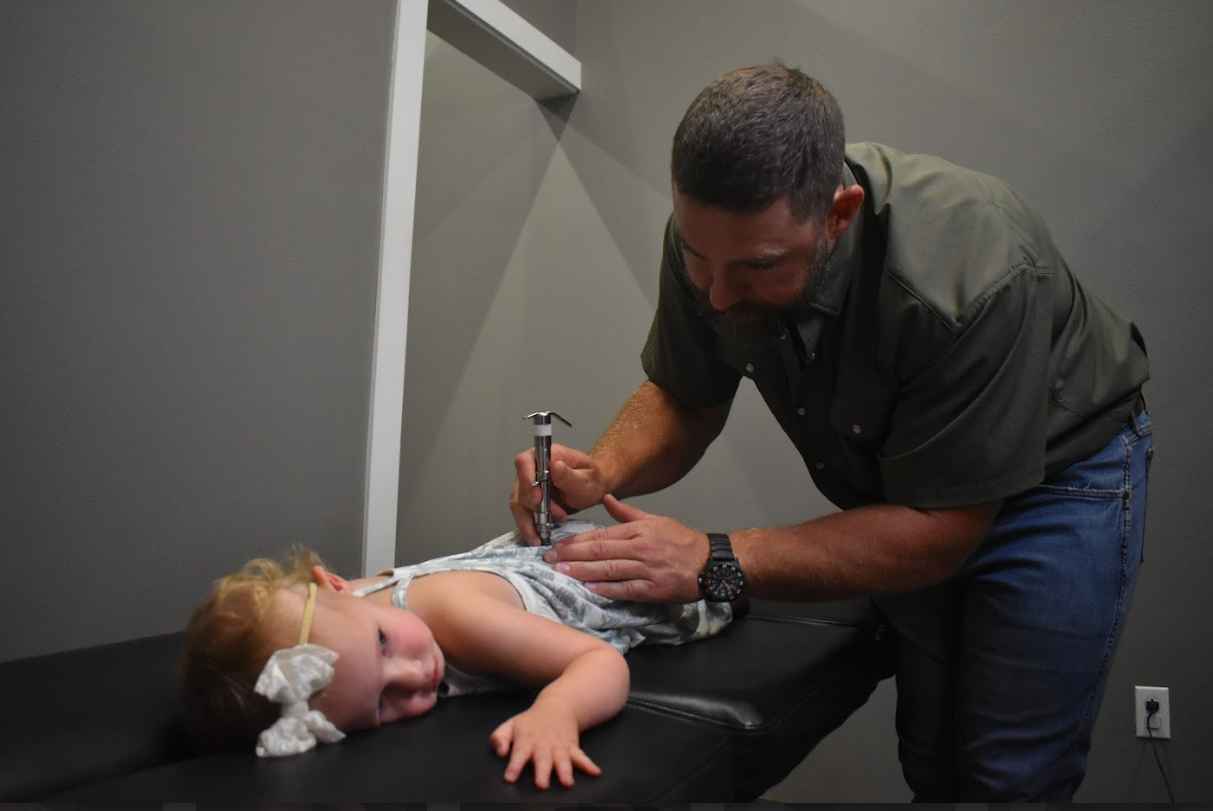
This is where most parents are surprised. An adjustment for an infant looks nothing like an adjustment for an adult. There's no cracking. No twisting. No popping. No force in the way most people picture chiropractic care.
For a newborn, the pressure used is roughly what you'd use to check a ripe tomato — light enough that the baby usually doesn't even notice. The goal isn't to move bones into place. It's to provide a small, specific input into the nervous system at the spots where it needs help reorganizing itself.
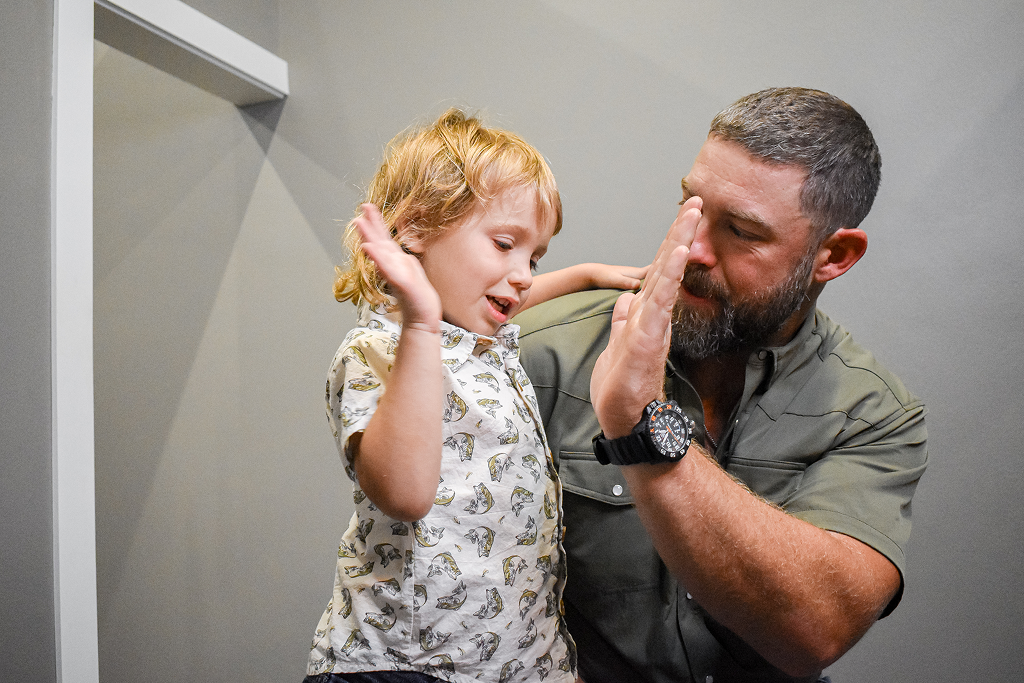
Most of our infant practice members fall asleep during their visits. The ones who don't are usually more relaxed afterward than they were when they came in. Parents often tell us the change shows up later that day or the next morning — better sleep, calmer behavior, an easier feed.
Some symptoms in infants are not chiropractic problems. Fever in a baby under three months, projectile vomiting, refusing to feed entirely, lethargy, or any sudden change should go straight to a pediatrician or the ER. Chiropractic care supports a healthy nervous system — it does not replace medical evaluation when something acute is happening.
The first year of milestones and movement.
By the end of the first year, your baby will have gone from barely able to hold their own head up to standing, cruising, and often taking first steps. Each of those milestones depends on the brain, spinal cord, and muscles communicating cleanly — and on the baby being able to move freely enough to practice.
Restrictions and tension in the spine during this window don't always cause obvious symptoms, but they can quietly make certain movements harder than they should be. We see this most often in babies who consistently turn their head only one direction, prefer one side when feeding, skip crawling, or favor one arm or leg. None of these are emergencies, but they are signals worth paying attention to.
The earlier these patterns are caught, the easier they are to address — because the nervous system at this age is built to adapt.
Who pediatric chiropractic care is for.
The parents who tend to find their way to our office with an infant or young child are usually dealing with one of a few things:
- A difficult birth — forceps, vacuum, emergency C-section, prolonged labor
- Colic, excessive crying, or a baby who can't seem to settle
- Sleep difficulty beyond what feels normal
- Feeding or latching challenges
- Reflux, gas, or digestive discomfort
- A strong head-turning preference or asymmetry
- Delayed or skipped milestones
- Or, increasingly, parents who just want their child checked the way they'd want them checked at a pediatrician — not because something is wrong, but because they want to know the foundation is in good shape
All of those are reasonable reasons to come in. None of them require a referral, and none of them require something to be "wrong" first.
What to expect at your baby's first visit.
The first visit is mostly conversation. We want to know about the pregnancy, the birth, what you're seeing at home, and what you'd like help with. Then we do a gentle neurological assessment — checking how your baby's nervous system is communicating, where it's regulated, and where it's not.
If we don't think we can help, we'll tell you. If we think something needs a pediatrician or specialist first, we'll tell you that too. And if your baby is a good fit for care, we'll explain exactly what we'd recommend, what it would look like, and what to watch for as a sign it's working.
The babies we see are part of the same neurologically-based approach we use with every patient — the same one that drives the rest of what we do. The body knows how to regulate itself. Our job is to remove the interference and let it.
If you're considering care for your child.
Whether your baby is two weeks old or your child is two years old, the first step is the same: a real evaluation, a real conversation, and an honest read on whether pediatric chiropractic care is likely to help.
Call (210) 343-5209 or book an evaluation online. We'll take it from there.